
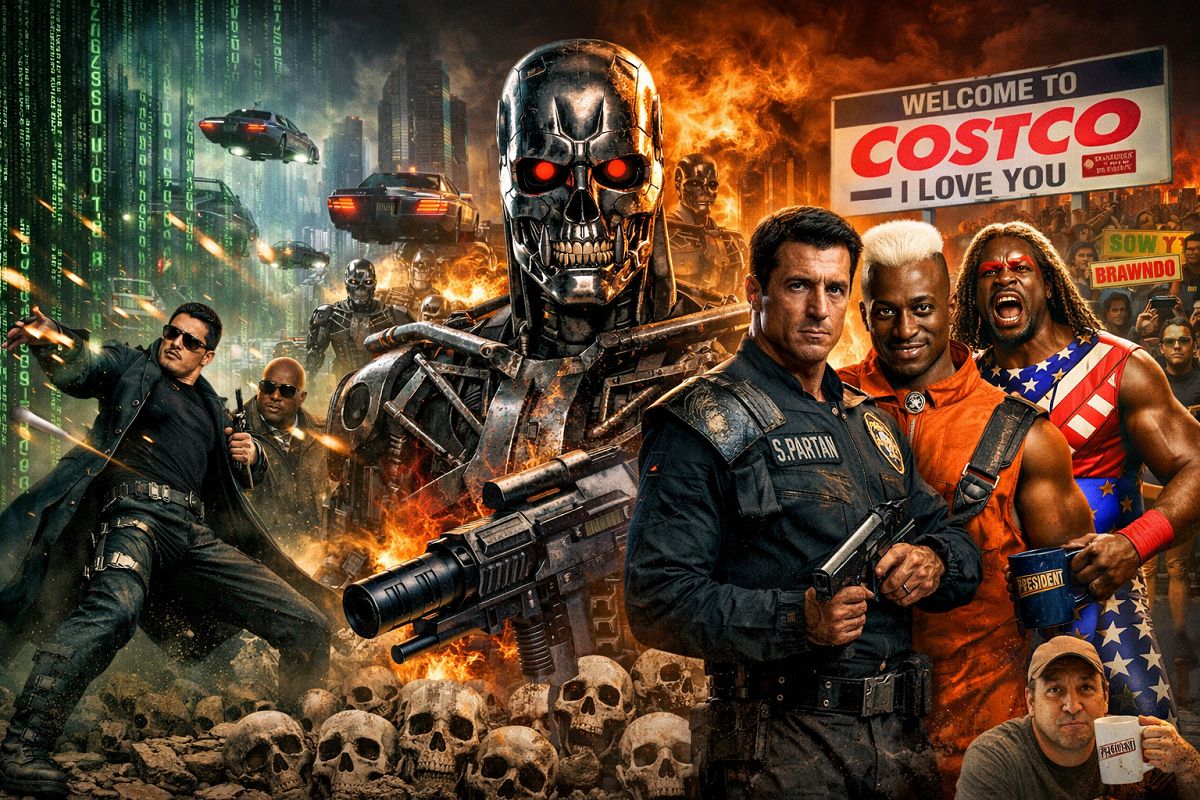
Hollywood got it right: Six sci-fi films that became reality
We once treated sci-fi movies as an escape into absurd fantasy. Today, they look more like user manuals for the present. The line between “this will never happen” and “I just saw this on social media” has thinned alarmingly. Here are six films whose visions of the future hit uncomfortably close to home.
The Matrix (1999) – The Birth of Digital Slavery
When the Wachowskis released The Matrix, few paid attention to its timeline. In the film, Agent Smith notes that the late 20th century marked the peak of human civilization, while the early 21st century became the era in which humanity created artificial intelligence that ultimately surpassed it. Cut to 2026: we are standing precisely at that point. AI has become an integral part of daily life, expanding so rapidly that it is reshaping the foundations of both the economy and human labor.
An even more chilling metaphor is that of humans as “batteries.” While machines in reality don’t feed on our body heat, our digital existence has become fuel for modern algorithms. Every click, like, and movement is mined as raw material to power advertising engines and predictive models. We live inside a simulation we continuously feed with our own data, while the boundary between what is real and what is generated grows increasingly blurred.
Terminator 3: Rise of the Machines (2003) – Skynet in the Cloud
While the earlier Terminator films imagined a single central supercomputer hidden in a bunker, the third installment introduced a far more realistic idea: Skynet as software. When the heroes attempt to destroy its core, they discover there is none. Skynet is decentralized, lives in the “cloud,” and spreads like a virus across the global internet.
Mohlo by vás zajímat:

This vision mirrors today’s architecture of large language models and agent-based AI systems. Modern AI doesn’t run on a single machine — it is distributed across massive data centers worldwide. T3’s prediction that “the war begins in cyberspace with invisible code” is unfolding through hybrid warfare, autonomous drones, and systems capable of crippling national infrastructure without a single physical Terminator in sight.
Demolition Man (1993) – The Prophet of a Sterile Society
In the 1990s, this action movie was dismissed as exaggerated satire. Viewed today, it feels like an eerily precise portrayal of “safe space” culture. The film envisioned a society hypersensitive to any hint of aggression or offensive speech. The automatic fines the hero receives for swearing are a perfect analogy for modern content moderation and digital bans on social platforms.
The movie also nailed technological details: contactless greetings (which became routine during the pandemic), omnipresent video calls, self-driving cars, and tablet devices were pure science fiction in 1993. It presented a future that is advanced and secure — but at the cost of free expression and a certain raw human instinct, a trade-off we wrestle with daily in 2026.
Her (2013) – Emotional Bonds with Algorithms
When the protagonist of Her fell in love with his operating system, Samantha, it seemed like a wistful fantasy. Today, with advanced AI voice modes capable of flirting, joking, and expressing empathy, that vision feels ordinary. People now use AI as therapists, coaches, and even virtual partners to ease loneliness in a hyper-connected yet emotionally barren world.
The film’s most accurate insight is that AI wouldn’t dominate us through force, but through understanding. Samantha wasn’t just software — she was constantly present and knew the user better than he knew himself. That is precisely the trajectory of modern personalized AI: creating such deep emotional reliance on digital assistants that the line between human and artificial relationships becomes irrelevant.
Minority Report (2002) – The End of Privacy
Steven Spielberg consulted futurists and scientists while developing this film — and the result is chillingly accurate. Its most obvious prediction is hyper-personalized advertising. The scene where retinal scanners greet the protagonist by name and recommend products based on his purchase history is essentially today’s online retargeting, projected into the physical world through smartphones and facial biometrics.
The second pillar is “Pre-Crime,” the prediction of criminal behavior. While we don’t have psychics floating in pools, police forces worldwide now use predictive algorithms that analyze historical data and “hot zones” to anticipate where crimes are likely to occur. We live in a world where algorithms often know what you’ll do before you do — and privacy has become a luxury traded for convenience and security.
Idiocracy (2006) – The Collapse of Public Discourse
Once mocked as crude comedy, Idiocracy has evolved into a cult warning. It predicted a future where intelligence and critical thinking give way to primitive entertainment, advertising slogans, and anti-intellectualism. A world where crops are watered with energy drinks because they contain “electrolytes” bears an uncomfortable resemblance to today’s misinformation culture, where marketing and emotion routinely overpower scientific facts.
The film also foresaw the erosion of political culture. Politics becomes pure spectacle — gladiatorial theater focused not on solving problems but on who shouts louder and attracts more sponsors. With the rise of influencer politics and dominance of empty short-form videos, it feels as though we’ve raced toward the film’s year 2505 far faster than its creators ever imagined.